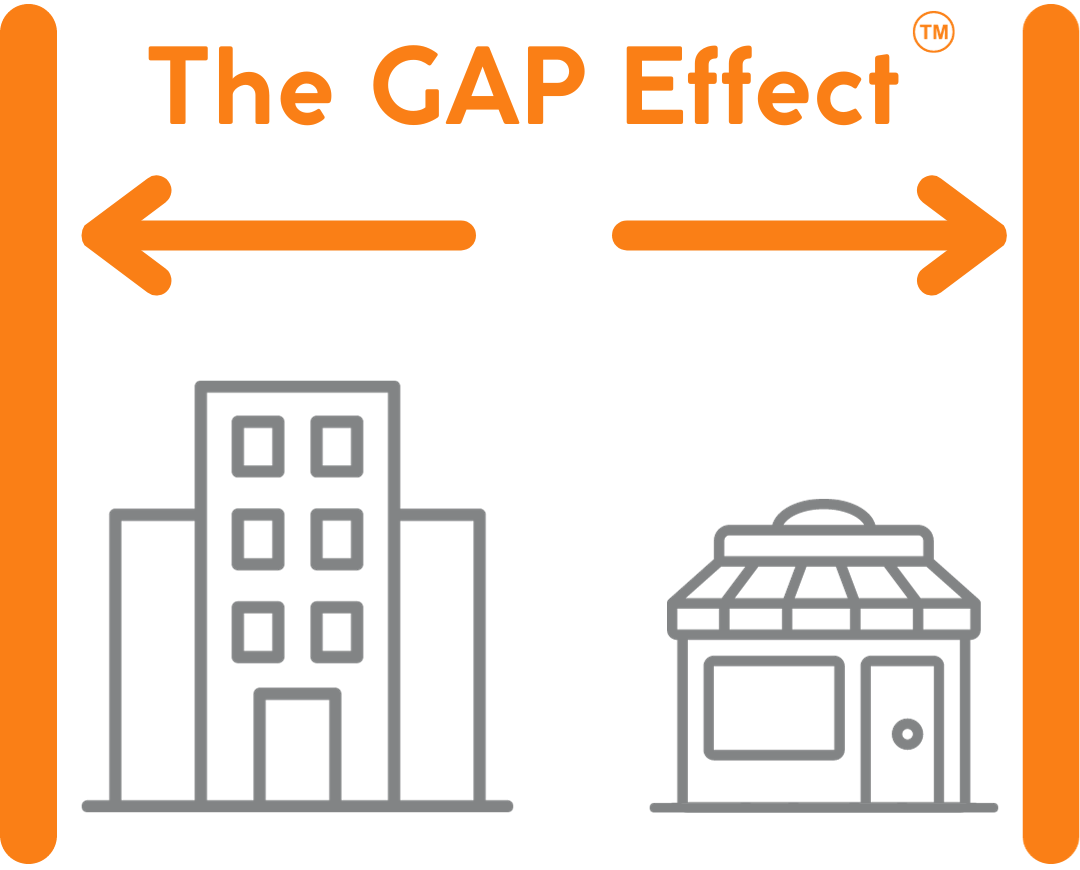
If you are a small business owner trying to work with large organisations, you already know it can feel like there is a chasm between the two worlds. I call this divide The GAP Effect.
It’s the invisible space that opens up when big companies and small businesses try to work together, but misunderstandings, mismatched expectations, and power imbalances get in the way. It’s as though the two parties are speaking different languages.
The irony is that both sides need each other. Big companies need small suppliers for agility, innovation, and specialist expertise. Small companies want the stability and opportunity that corporate contracts can bring. Yet time and again, both sides find themselves frustrated, and all businesses, communities, society, and the economy as a whole are affected as a result.
That is The GAP Effect in action
What Is The GAP Effect?
Over many years of running my own consultancy, writing, and speaking with thousands of SMEs and corporate managers, I have seen the same disconnects appear again and again. In my book Small Company, Big Business, I described three big ones:
-
Complexity – Large companies have complicated systems and processes. To a small supplier, they often feel impenetrable.
-
Cost and Time – Compliance requirements, capability statements, and tendering all consume precious SME resources.
-
Getting on the Radar – Many small businesses struggle simply to be noticed, no matter how good they are.
Together, these issues create a barrier that feels like a gap too wide to cross.
Why The GAP Effect Matters
When the gap isn’t bridged, both sides lose.
For corporates, failing to engage SMEs means missing out on innovation, local insights, and supply chain resilience. We saw this vividly during COVID, when international supply chains collapsed and companies suddenly rediscovered the value of local suppliers.
For SMEs, the consequences can be even harsher. Late payments from big buyers can cause a cashflow crisis that ripples through whole regions. Excessive compliance demands can make tendering uneconomical. And being treated as a “risky” supplier often means missing out on contracts altogether.
The broader economy also suffers. Research has shown that if Australian corporates simply paid SMEs on time, thousands of jobs would be created and millions added to regional economies. That is the very real cost of The GAP Effect.
How SMEs Can Close The GAP
While the system may feel stacked against you, there are practical ways SMEs can close The GAP Effect from their side.
-
Understand supply chains. The big company sees you as one link in a long chain. If you break, they fail. That’s why demonstrating reliability is non-negotiable.
-
Show financial stability. Corporates will ask for your financials. Be ready to demonstrate that you are not a risky bet.
-
Master DIFOTQ. Delivery in Full, On Time, with Quality. It doesn’t mean gold-plated products, but it does mean consistent performance.
-
Highlight value beyond price. Don’t assume cheapest wins. Many corporates are moving toward value-based procurement, which includes long-term benefits, service, and trust.
-
Do your homework. Every industry and every company has its own rules, language, and culture. You need to learn them before you step up.
In short: preparation and professionalism matter. SMEs that invest in these foundations are far more likely to succeed.
What Corporates Must Understand
Of course, SMEs can’t close the gap alone. Corporates must also adjust their mindset.
-
Payment terms matter. Using small suppliers as a source of cheap credit is not sustainable. Fair payment builds stronger supply chains.
-
Partnership beats procurement. Adding SMEs to a supplier list is not enough. True diversification means engaging them as real partners.
-
Communication builds trust. Too often, small suppliers are left in the dark. Transparency and consistency make all the difference.
-
Mutual flexibility. SMEs showed extraordinary adaptability during the pandemic. Large companies must show the same willingness to adjust.
-
Reconsider the power dynamic. Traditional models like the Kraljic Matrix put all power with the buyer. But SMEs also choose which corporates they want to work with. Treating suppliers as disposable can backfire.
When corporates value SMEs as long-term partners, they gain not only products and services but also innovation, loyalty, and resilience.
A Story From the Trenches
When my own consultancy first landed a contract with a large mining company, it was a steep learning curve. We had the technical expertise, but we didn’t fully understand the rules of working with such a big client. We learned quickly that it wasn’t just about doing good work — it was about aligning with their systems, proving financial stability, and demonstrating that we could deliver every time.
That first contract was tough, but it became the springboard for 20 years of successful partnerships. The lesson was clear: bridging The GAP Effect takes preparation, persistence, and trust.
Closing Thoughts
The GAP Effect is real, but it doesn’t have to be permanent. It can be closed when small businesses prepare properly, and when big companies step up as fair and respectful partners.
If we succeed, everyone benefits. SMEs get opportunities to grow, corporates get stronger supply chains, and communities get jobs and investment.
Want Your Audience to Understand The GAP Effect?
The GAP Effect is one of the most important but least discussed challenges in modern business. It’s also one of the topics I speak about most often.
In my keynote “The GAP Effect”, I explain what the gap is, why it matters, and how both sides can work together to close it. If you want your audience to gain real insight into SME–corporate partnerships, click here to enquire about booking me as a speaker.